Nabulsi (or naboulsi) cheese is one of the most popular white brined cheeses made in the Middle East. Its name denotes its place of origin, Nablus, Palestine and it is well-known throughout Palestine, Lebanon, Syria and Jordan.Nabulsi cheese is produced primarily from goat milk but sheep’s milk can also be used. Nabulsi cheese is white and rectangular in shape. It is semi-hard with no gas holes. It becomes soft and elastic when heated making it idea for frying or grilling.
Nabulsi cheese can be eaten fresh as salty table cheese, can be used as a stuffing for phylo dough, short crust pastry or a simple pita pocket. Fried in oil it makes a great appetizer, sweetened it can be used in different middle eastern desserts such as kinafeh or kataief.
Growing up it was always my grandmother who sent us the nabulsi cheese we needed for a whole year. She bought it from people who have their own goats and are specialized in making this type of cheese. Then my parents decided to give making nabulsi cheese at home and the results were amazing, only they made a variety that is less salty and less firm that can last in the fridge for a couple of weeks as opposed to the firm salty nabulsi cheese that you can store at room temperature for up to a year. I am sharing both recipes with you today.
I personally started making cheese thanks to John over at from the Bartolini kitchens and Tanya from Chica Andalusa. It all started with ricotta and when you taste homemade cheese there is really no turning back. I made cottage cheese and yogurt cheese, feta cheese and now the queen of all cheeses, Nabulsi cheese
The milk:
You can make Nabulsi cheese with fresh unboiled goat milk or sheep milk. Sheep milk tends to have more fat and more protein and more milk solids when compared to goat cheese. Sheep milk will give you a greater amount of cheese but goat milk will give you a better tasting cheese that will last longer.You cannot use ultra-pasteurized milk .The temperature and time combination is lethal to bacteria, killing virtually all that would be beneficial in cheese making.
Additional information on where you can find raw milk in the USA can be found at here
To boil or not to boil:
To make Nabulsi cheese you need to start with fresh unboiled milk as with pasteurization, boiling changes the milk in a way that prevents the formation of the large firm curds needed to make nabulsi cheese.The cheese will be boiled after it is finished to sterilize it.
Rennet:
you can use tablet rennet or liquid rennet. You may find liquid rennet easier to measure accurately. 1 tsp Liquid rennet equals 1 rennet tablet. 1 rennet tablet is used for 20 liters of milk
Home made Nabulsi cheese
5 liters Fresh sheep milk
1/4 tablet of rennet
Salt
2 cups water
Heat the milk up tp 40 C or until it is slightly warm to the touch
crush 1/4 tablet of rennet using the back of a spoon , add 2 cups of water and stir till it is completely dissolved
Add the rennet water to the milk and stir well to make sure the rennet is well distributed throughout the milk
Once you add the rennet you need make sure not to disturb the milk, cover the milk pot with a lid and place it in a warm place covered with a blanket
Leave undisturbed for 2 hours. After two hours you will find that the milk has separated into one big block of cheese and whey
Using a plate of a big ladle transfer the cheese to a colander lined with a cheese cloth or a clean fabric with fine weave. You want to keep the cheese curds as big as possible, that is why you use a plate or a big ladle.
Allow the cheese to drain for a couple of hours, once it starts to firm up a little,sprinkle with a little salt (1/4 teaspoon) gather the edges of the cheese cloth to cover the cheese and place a heavy weight on top of it to help it drain, leave over night
The next morning your cheese should be one mass that is slightly firm
Flip over a plate that you have sprinkled with salt
Cut into rectangles and sprinkle the top with salt. At this stage the cheese is still soft and needs to be handled with care. the salt will draw out more whey from the cheese and allows it to harden.
leave the cheese undisturbed till evening, flip and sprinkle with salt and leave over night.
The next morning flip the cheese again and sprinkle with a little salt and leave till the evening.
In the evening arrange the cheese in a container separating each layer with nylon bag that you have sprinkled with salt.
Leave in the fridge for 3-7 days. During this time the cheese will continue to hard due to the presence of the salt.
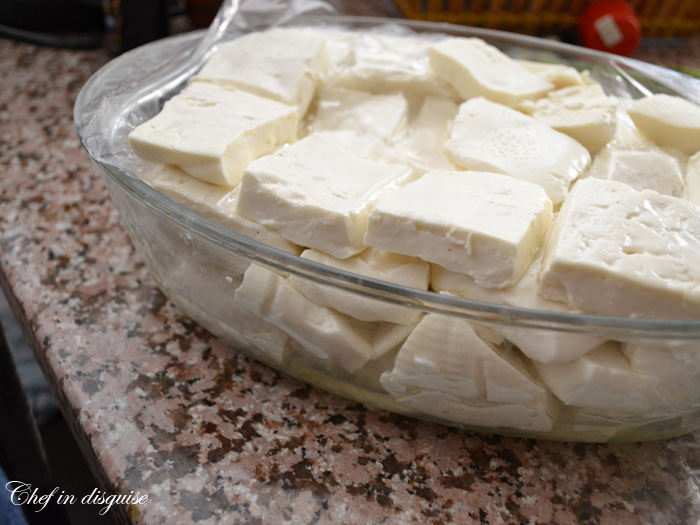
After 3-7 days your cheese is ready to eat, you only need to boil it first.
To boil the cheese, heat water in a pot till it boils then add the cheese a couple of rectangles at a time, lower the heat and cook for 3-5 minutes.
Using a slotted spoon take the cheese gently out of the water and allow to cool on a plate
Boiling softens the cheese that is why you need to handle it with care until it cools and firms up again
Nabulsi cheese made this way will last up to 2 weeks in the fridge.
If you want to store the cheese for a year you will need to make the following alterations to the instructions
- instead of leaving the cheese outside the fridge for 2 days, you need to leave it out for a week sprinkling with salt each morning and evening (the amount of salt you sprinkle is small, similar to what you will sprinkle over a dish or a meal but the amount adds up because you repeat the salting twice a day) the salt is meant to draw out the whey and harden the cheese and that will allow it to live longer
- To brine the cheese you need 1 cup of salt for every 6 cups of water. Bring to a boil, add flavoring agents (traditionally mahlab and mastic are used)
- If you want to flavor the cheese you can add 1/2 teaspoon of mastic and 1/2 teaspoon of mahlab (both whole not ground) and wrap them in a cheese cloth or another fine weave clean fabric and add them to the boiling water after the cheese has set in the fridge.
Another option would be to add only the mahlab to the boiling water and add the mistaka to the jar you store the cheese in. You slightly grind 1 teaspoon of mastic (you just want to break up the crystals a little) and sprinkle it between the layers of cheese in the jar. - If you would like to add the black seeds do it after the straining the cheese for a couple of hours when you sprinkle the salt and cover it and weight it early in the cheese making process. Do remember to clean the black seeds, preferably wash them and allow them to dry or they will be a source of contamination and may ruin your cheese. There is also a slight risk that the black seeds will cause the cheese to be darker in color. I personally don’t add black seeds to nabulsi cheese
- Add the cheese rectangle 4-5 at a time and boil until the cheese starts to bubble slightly
- Using a slotted spoon take the cheese out of the brine and allow to cool on a plate
- Repeat with the remaining cheese till you have boiled the entire amount
- Allow the brine to cool
- Arrange the cheese in a jar and cover with the cooled brine
- Store in a cool place for up to a year.
- Cheese made this way will be quite salty but that is necessary to preserve it, when you want to eat it you can either soak it over night in water or boil in water for a couple of minutes
Trouble shoot
My milk did not form clots
- Use of ultra-pasteurized dairy products.
- Over-heating the milk and thereby killing the live cultures.
- Using rennet that’s too old or not using enough.
- Not waiting long enough for the curd to form.
My cheese won’t firm up
- You did not sprinkle with salt
- The weight you used to press the cheese is not heavy enough
My cheese crumbled when I boiled it
- you boiled it for too long
- you did not leave it in the fridge long enough to harden
So you have made Nabulsi cheese and now you don’t know what to do with it?
How about these recipes for a start
Fteer falahi (Cheese and anise flat bread


Jenine
/ April 12, 2013sawsan,
I have just attempted to make my cheese as you directed, for some reason it didnt quiet hold after 2 hours as you said. i used 1 gallon of milk to 1 whole rennet tablet to make sure it holds, but i will be honest with u i think my milk may have been hot. should it be warm as if u r warming milk for an infant? I would like to call you in amman and better undwerstand. I am from amman too if you dont mind my email is jeninelhindi@yahoo.com if you would like to hit me with an email so i may contact you for better advice.
thanks your sister
jenine
Jenine
/ April 12, 2013hi sawsan
i wanted to know when can i add the habbit el barakeh to my cheese when making it. at what point should i put it?
Sawsan@ Chef in disguise
/ April 12, 2013Hello Jenine
I would sprinkle it as I am ladeling the cheese curds to strain in the colander but make sure that you have washed and dried the habbit el barakeh before using it. Or else it might contaminate the cheese
narf77
/ March 14, 2013That cheese looks seriously good! My husband is a cheese addict and would love something like that so I am going to give it a go, thank you so much for sharing the recipe
Rawan
/ March 11, 2013Hello there! I was wondering if you or any of your followers out therr would know where I can buy knafeh nabilsiyeh in Melbourne? I’m dying to have some, and all the shops I stop at only have knafeh with ishta
thanks for the help, your food looks great, keep it up!
Amal
/ January 2, 2013Salams Sawsan, What is rennet called in Arabic? Im in Jordan and would like to know where I could purchase this from.
Sawsan@ Chef in disguise
/ January 3, 2013اهلا امل…اسمها دورا او منفحه و بتلاقيها بالصيدليات
Amal
/ January 3, 2013Thanks so much Sawsan. Another question Ive got access to Cows milks but if I didnt could you make it with powdered milk?
Are you still based in Amman
Sawsan@ Chef in disguise
/ January 4, 2013I have never tried it with powdered milk, not sure if it will work. I read once that you can use powdered milk in cheese making but you have to add heavy cream to it but I never tried it.
I will try it out and let you know
I am still based in Amman yes
Island girl
/ December 31, 2012can i use cows milk?
Sawsan@ Chef in disguise
/ December 31, 2012Only pasturiesed milk would work, ultra pasterized cow milk won’t work. Or better yet, use raw cow’s milk from a source you can trust
Tayeb
/ December 26, 2012Salam Sawsan, great recipes and tips, when you boil cheese to store I think, remembering the old days back in Palestine watching my mother and grandmother on our annual cheese boiling rituals add ” مستكه” to the boiling water for cheese to give it special aroma , you could also add black sesame seeds to cheese “حبه البركة” to give the cheese a distinctive flavor !.
Sawsan@ Chef in disguise
/ December 26, 2012Ahlan Tayeb
You are right. My mother does that too but for the cheese stores long term. The mastic does add amazing flavor
Shema George
/ December 4, 2012Wow..you are such a great cook..I would love to make this someday and I am sure I will come back to this recipe
Sawsan@ Chef in disguise
/ December 5, 2012Thank you Shema, I can’t wait to hear how it turns out
zeina
/ December 2, 2012Hi Sawsan,
im zeina hamze from lebanon but now i live in Belize..
while i was searching for Nabulsi cheese for making kunafah..i found ur page..and im so glad to pass on it…your cheese looks amazing,and i was very need of it..thank you for u
one question..here i can’t found sheep or goat’s milk..can i make it with powder milk..or cow’s milk(liquid)..thank u in advance..
zeina
/ December 2, 2012Hi Sawsan,
im zeina hamze from lebanon but now i live in Belize..
while i was searching for Nabulsi cheese for making kunafah..i found ur page..and im so glad to pass on it…your cheese looks amazing,and i was very need of it..thank you for
one question..here i can’t found sheep or goat’s milk..can i make it with powder milk..or cow’s milk(liquid)..thank u in advance..
do u know arabic?!..
Sawsan@ Chef in disguise
/ December 2, 2012اهلا زينه
Thank you for your kind comment
Yes I know Arabic
Sadly this type of cheese won’t work with cow’s milk. There is a recipe I need to try that uses powdered milk and cream. I will let you know if it works out
zeina
/ December 2, 2012thank u so much..
انا بعمل جبنة من جليب البودرة..بس اكيد مش متل ال بتعمليها..بعملها بالخل(استعملت المنفحة حصلت على نفس النتييجة ) استعملتها بالكنافة بس ما بدوب لوحدها الا اذا استعملت الموزريلا معها..طيبة بس مش متل الجبنة النابلسية او العكاوي..
الله يعطيكي العافية يا رب على الموقع الرائع….
Sawsan@ Chef in disguise
/ December 2, 2012اهلا زينه..
الجبنه اللي بتحكي عنها في ناس بيسموها
paneer و في ناس بيسموها easy ricotta
هي مثل ما حكيتي ما بتذوب بالحراره
اللي انا قصدته انه في وصفه شفتها بتستخدم حليب بودره و كريما و منفحه بس ما جربتها
اسفه اني ما قدرت ساعدك اكثر و شكرا للطفك
zeina
/ December 2, 2012ست سوسن..
على امل تجربيها وتعطينا النتيجة…وانا على يقين انوالنتيجة حتكون رائعة متل هذه وكتير من الوصفات الرائعة انشاءالله
شكرا كتير الك وانشاءالله منجرب النابلسية الرائعة بس انزل على لبنان
Sawsan@ Chef in disguise
/ December 3, 2012كلك زوق يا زينه…شكرا للطفك
Eman Alghoul
/ December 1, 2012how can I buy nabulsi cheese on line from london
Sawsan@ Chef in disguise
/ December 1, 2012Hello Eman,
I honestly don’t know, I tried googling it and came up with this site that sells Naboulsi cheese
http://www.shop.zaitwazatar.com/products.php?product=Al%252dFarida-White-Cheese
but I don’t know them and have never tried their cheese.
You may want to do a google search and see which results appeal sorry
Umm Aaminah
/ November 1, 2012Salaam! Great post and really inspiring! Is nabulsi cheese anything like akkawi cheese? Because I really want to know how to make the akkawi cheese
Sawsan@ Chef in disguise
/ November 1, 2012Salam Umm Aaminah
Nabulsi is very similar to akkawi but nabulsi is firmer and more salty but the two are similar. You can replace one with the other in most recipes
Yasmeen @ Wandering Spice
/ October 14, 2012Absolutely fantastic! I have fond memories of the Nabulsi cheese my great aunt in Jerusalem used to make. Now I can recreate this here, in my new life in Australia. This post really touched my heart… and my tastebuds
Sawsan@ Chef in disguise
/ October 14, 2012I am glad my post brought back happy memories Yasmeen. If you need any help with recreating the cheese please let me know
Khadijah
/ July 4, 2012As-salam alaykum sister! Where did you find rennet? I live in KSA and I’m not sure where to look. Thanks!
Sawsan@ Chef in disguise
/ July 4, 2012Wa alikom al salam wa rahmato Alla
I buy the rennet at the pharmacy here. Where exactly in KSA are you?
You can also buy it online, I can give you the links if you are interested
Khadijah
/ July 23, 2012As-salam alaykum wa rahmatullahi wa barakatu! I live in Dammam, alhamdulillah. Thanks for the pharmacy idea; that is probably the last place I would have looked!
Sawsan@ Chef in disguise
/ July 23, 2012Wa alikom al salam Khadijah. I hope you will be able to find it
Sami
/ July 4, 2012Salam Sawsan we live in Australia and we misse Kunafah so much as it is not avaialble here. My question is if we follow you cheese making recipe will this cheese be suitable for making Kunafah. I mean is it going to be strechy when heated?. I know how to make the white traditional cheese we eat in the middle east. I aways make it using cows milk but this cheese remains hard when heated. Thank you very much for this nice website
Sami
Sawsan@ Chef in disguise
/ July 4, 2012Ahlan Sami
If you follow my cheese recipe the outcome would be very suitable for kunafeh.
If you want to make the cheese to be stored for a year it will be really salty so what you have to do is slice it into thin strips and soak it in water, change the water every 3-4 hours till the cheese is sweet
Your second choice would be to make the cheese that lasts a couple of weeks in the firdge and this one would be perfect for kunafeh, you can either boil it for a couple of minutes to reduce the salt or soak it for a couple of hours and you are good to go. The cheese will be soft and streachy.
Another trick I learnt from a friend of mine is to replace 1/3 of the cheese with mozzarella to help with the melting
I hope this helps and if you have any more question I would be more than happy to help
Thank you for following my blog
Yasmeen @ Wandering Spice
/ October 14, 2012Hi Sami. I’m also in Australia – in Melbourne – and can recommend some great places for knafeh here if you’re interested. Great idea through to use Sawsan’s recipe at home! I’m sure it’s delicious.
Anonymous
/ October 15, 2012I am difinatly interested in Knafe Nabilsiyah and not the lebenese type. I look forward to hearing from you.
Regards
Rawan
/ March 12, 2013Yasmeen, help! I want knafeh nabulsiyeh in Melbourne! Where can I get some?
fati's recipes
/ June 17, 2012Sawsan my darling! Thank you SO much for this recipe! I can’t wait til I try it. Thanks for all the troubleshooting tips, too
If I get caught up with study/teaching, I’ll have to opt for using goat’s cheese for the nabulseeyah, but I really hope I can try this out!
Sawsan@ Chef in disguise
/ June 17, 2012I am glad you like it Fati and I really hope you’ll have the time to give this a go
Karen
/ June 9, 2012For those who can get the fresh unboiled milk, this is an inspiring post. You always have such wonderful tutorials, Sawsan.
Sawsan@ Chef in disguise
/ June 13, 2012Thank you kindly Karen for your sweet comment
sybaritica
/ June 9, 2012I’d love to try that … is it anything like Feta Cheese?
Sawsan@ Chef in disguise
/ June 12, 2012Not quite, it is firmer in consistency and it has a unique flavor that is all its own
hotlyspiced
/ June 8, 2012Congratulations on making your own cheese. Like you, I have been inspired to make cheese thanks to John. Your cheese looks amazing and what a great skill to add to your repertoire! xx
Sawsan@ Chef in disguise
/ June 12, 2012Thank you Charlie, it is indeed a great skill to add and quite enjoyable
Korena in the Kitchen
/ June 8, 2012This sounds delicious Sawsan. I’ve got homemade cheese on my “to make” list and this was very inspiring to read
Sawsan@ Chef in disguise
/ June 12, 2012I know you will love homemade cheese Korena, there are so many options and it is so much better than store bought cheese
Bam's Kitchen
/ June 7, 2012Very impressive. You have so much patience. What is your favorite dish to make with this type of cheese?
Sawsan@ Chef in disguise
/ June 7, 2012Thank you so much Bam.
I love this cheese cubed with watermelon. It is amazing fried and I love it in pastry
Maureen (@OrgasmicChef)
/ June 6, 2012I love making cheese but I’ve never made this one. I hadn’t ever heard of it. Sounds delicious though. You’re right about homemade cheese tasting fantastic.
Sawsan@ Chef in disguise
/ June 7, 2012Hello Maureen, when you make your own cheese there is really no turning back
Courtney
/ June 6, 2012Oooh, a new cheese! That always makes me happy. I definitely need to get on this cheese making bandwagon!
Sawsan@ Chef in disguise
/ June 7, 2012You will have loads of fun with cheese Courtney and it tastes so good!
mona
/ June 5, 2012all your dairy posts brought back such sweet childhood memories, of living abroad and having hanging cheesecloths to make labneh or having big pots and bowls in the kitchen corner under blankets… bringing a bit of home with you where ever that may be.
Sawsan@ Chef in disguise
/ June 6, 2012I am glad I brought back sweet memories Mona..I loved what you said, food does indeed brings a bit of home to wherever you may be
Eva Taylor
/ June 5, 2012This looks awesome, Sawsan. I am definitely intrigued by home made cheese and I have already passed the entry level John’s home made ricotta! I like this one that it’s not brined quite as much as feta, perhaps this will be my next attempt at cheese. I loved your Fteer falahi — my second attempt was much more successful (I made it at the cottage on the long weekend in May, post to come soon).
Sawsan@ Chef in disguise
/ June 7, 2012I am really glad to hear that the second attempt was much more successful, looking forward to your post and if you decide to make this cheese and need any help, just send me an email
Chica Andaluza
/ June 5, 2012This is amazing! As soon as I can get hold of some liquid rennet I will be making this. Have never seen cheese which is boiled afterwards, am curious as to how it tastes! Thanks too for the lovely mention – we need to get together and start a cheese making co-operative
Sawsan@ Chef in disguise
/ June 7, 2012Oh that would be loads of fun! I wish we could get together and cook, bake and talk…that would be a day to remember
if you have a chance to try this, I would love to hear what you think of it
Kristy
/ June 5, 2012Ahhh…..cheese. I need to try it this summer. It’s on my list. I just find it so intimidating, but you and Chicago John just make it look so good and not too hard. We’ll see…I’ll keep you posted. Gorgeous photos Sawsan!
Sawsan@ Chef in disguise
/ June 5, 2012You and the kids will have loads of fun with cheese Kristy, start with the easy ones like ricotta and you will be hocked before you know it
Thank you for your kind comment on my pictures
Sawsan@ Chef in disguise
/ June 5, 2012You and the kids will have loads of fun with cheese Kristy, start with the easy ones like ricotta and you will be hocked before you know it
Thank you for your kind comment on my pictures
Jessica Maher (@kbelleicious)
/ June 5, 2012you did not just make your own cheese?> What! Girl, I am totally impressed!
Sawsan@ Chef in disguise
/ June 5, 2012You are too kind Jessica, it is really easier than it seems
ChgoJohn
/ June 5, 2012Congratulations, Sawsan, on tackling another cheese! You are so right, “Once you taste homemade cheese there is really no turning back.” I’ve never tried nabulsi cheese but I know a Middle-Eastern grocery that might sell it. I hope so. Unable to get raw milk here, i don’t think I could make it correctly. Then again, if I buy some and love it, I just might end up looking for a way to get some raw milk.
Sawsan@ Chef in disguise
/ June 5, 2012All thanks go to you John, I wouldn’t have started all this if it wasn’t for your encouragement
The link I provided has a few places where they deliver raw milk to chicago, I don’t know how much they charge but maybe you can check it out if you like the nabulsi cheese
ChgoJohn
/ June 12, 2012I am familiar with that chart; the website that originated it is listed as a source on my Cheesy Stuff page. It is only legal to buy raw milk in the state to the north of me but the distance is too far to make it worth my while. In the other neighboring states, I can get access to raw cow’s milk if I buy a “share” of their dairy herd. It just isn’t feasible for the relatively small amounts that I need. I have a good source for milk that is pasteurized at a low temperature and will have to be contented with that — until I buy a cow!
Thanks for the suggestions. I do appreciate them.
Sawsan@ Chef in disguise
/ June 12, 2012I was just trying to help John, sorry it didn’t work out. I was meaning to tell you that I got my parents addicted to your feta cheese, they LOVE it and they are some of the pickiest people I know when it comes to cheese..thank you for giving them a recipe they really enjoy
Rufus' Food and Spirits Guide
/ June 5, 2012Looks simply wonderful!
Sawsan@ Chef in disguise
/ June 5, 2012Thank you kindly
A_Boleyn
/ June 5, 2012What gorgeous cheese. Unfortunately I can’t find fresh milk … goat OR sheep locally so I’ll just admire your industry.
Sawsan@ Chef in disguise
/ June 5, 2012Sorry you can’t find raw milk but at least I am glad you found the post informative
Sawsan@ Chef in disguise
/ June 5, 2012Sorry you can’t find raw milk but at least I am glad you found the post informative
A_Boleyn
/ June 5, 2012Although I won’t be able to make nabulsi cheese due to lack of the raw milk, I HAVE made paneer cheese which is wonderful in Indian dishes as well as some .
http://a-boleyn.livejournal.com/84086.html#cutid1 (making paneer)
http://a-boleyn.livejournal.com/82972.html#cutid2 (Indian mattar paneer)
http://a-boleyn.livejournal.com/84664.html (Hungarian curd cheese biscuits)
Sawsan@ Chef in disguise
/ June 6, 2012Thank you for the links,That mattat paneer sounds really tempting!
Choc Chip Uru
/ June 4, 2012Thank you for teaching me about yet another variety of cheese
Looks yummy!
Cheers
CCU
Sawsan@ Chef in disguise
/ June 5, 2012you are too kind Uru..this is my favorite type of cheese
Norma Chang
/ June 4, 2012Thanks for the cheese making lesson and information about this cheese. I would n’t be making this cheese anytime soon, but I sure would love to eat some fleer falahi and fatayer jebneh, they look so delicious.
Sawsan@ Chef in disguise
/ June 5, 2012Glad you liked it Norma
I think making cheese is really easy and the results are worth the trouble, I hope you will give it a go some day
bitsandbreadcrumbs
/ June 4, 2012What a wonderful post, Sawsan! I had not heard of or tried Nabulsi cheese, but now I really want to. And you make the process sound like fun…I love that you had some helping hands there at the beginning of the process.
I also love the look of the fatayer jebneh pastry. Thanks so much for sharing!
Sawsan@ Chef in disguise
/ June 7, 2012It was my mum’s hands actually, I took the first couple of pictures in my parent’s house, the rest were at my home.
I hope you will have a chance to try Nabulsi cheese, it is my favorite cheese of all time
ceciliag
/ June 4, 2012excellent tutorial but i only have cows milk.. well soon i will have cows milk if daisy every has her calf! and this looks so easy too.. i love home made cheese too, my cheese making will start very soon.. have a lovely day.. c
Sawsan@ Chef in disguise
/ June 7, 2012I look forward to all your cheese making posts Cecilia and I hope daisy will have her calf really soon
Terri Betz
/ June 4, 2012Awesomeness! Pinned n shared, n shared! I love your site! I just never tell you which makes me one stinky fan
But not today!
Thanks for all your work in bringing us some great memories n parties in our kitchen! You rock!
Sawsan@ Chef in disguise
/ June 5, 2012Thank you so much Terry for the comment, for following and for sharing. I am really glad you enjoy my recipes, your kind comment made my morning, thank you
flavorsofthesun
/ June 4, 2012This was a fascinating post. I’ve never made cheese using rennet, though I have long wanted to. And your step-by-step instructions make it seem so easy. I can almost taste this cheese as I read this post. Thank you.
Sawsan@ Chef in disguise
/ June 7, 2012It is really easy and once you taste it you will never buy cheese again. I just know that with all your experience you will do a great job with cheese
meriem
/ June 4, 2012Just to put a smile on your face and because your recipe is excellent!! I like to come here.I learn always something new. Thank you.
Sawsan@ Chef in disguise
/ June 7, 2012Thank you so much for your kind comment Meriem, you are so sweet